How to recycle magnets:

Neodymium Magnet Recycling

Neodymium magnets (NdFeB) are critical components in electric vehicles, industrial motors, robotics and data storage systems. As demand for rare earth materials continues to increase, neodymium magnet recycling is becoming essential to secure supply chains and reduce environmental impact.

MagnetIQ Technologies provides a short loop recycling solution that enables end-of-life magnets and production scrap to be converted directly into reusable magnet material.

A New Approach to Neodymium Magnet Recycling

Traditional recycling methods for NdFeB magnets involve complex chemical processes, including solvent extraction, electrolysis and metal refining. These processes are energy-intensive and result in loss of material value.

Our approach is based on hydrogen decrepitation, a proven technology that enables magnets to be broken down into reusable powder while preserving the magnetic material.

  • No chemical processing required
  • Lower energy consumption
  • Direct reuse of magnet material
  • Reduced CO₂ footprint
NdFeB magnets are widely used in electric motors (left) and hard disk drives (right), making them important sources for magnet recycling.

What is Hydrogen Decrepitation Technology?

Hydrogen decrepitation (HD) is a process in which hydrogen gas is introduced into NdFeB magnets.

Hydrogen penetrates the grain boundaries of the material, causing the magnet to break down into a friable powder while simultaneously demagnetising it.

This allows magnets recovered from assemblies such as motors and hard disk drives to be recycled efficiently. Without the need for energy-intensive chemical or metallurgical processing.

Hydrogen Decrepitation is a process (left) in which hydrogen gas is used to safely break down NdFeB magnets into reusable powder. Special HD decrepitation machines (right) are used for the process.

From Recycled Powder to New Sintered Neodymium Magnets

Recycled NdFeB powder obtained through hydrogen decrepitation can be directly reused in the production of new sintered neodymium magnets.

Unlike conventional recycling routes, the material does not need to be converted back into rare earth oxides or metals. Instead, it re-enters the standard magnet manufacturing process.

This enables a true short loop recycling approach, where end-of-life magnets are transformed back into new high-performance magnets.

The image on the left show magnets produced from recycled NdFeB material:

  • semi-finished segments on the left
  • fully finished, coated blocks on the right, ready for industrial use.

Recycled Magnets and Performance

With proper processing and blending, recycled NdFeB powder can achieve magnetic properties suitable for a wide range of industrial applications.

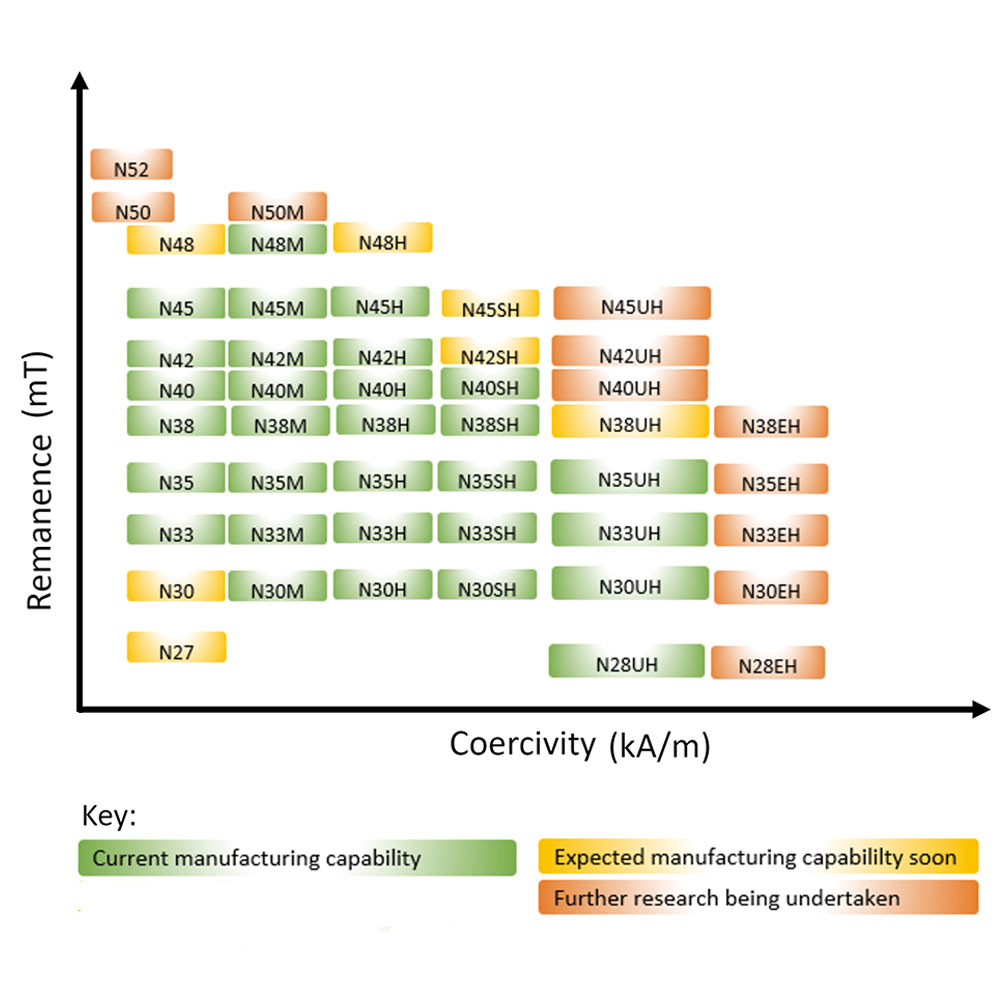
The chart below shows the range of NdFeB magnet grades, comparing remanence (magnetic strength) and coercivity (temperature and demagnetization resistance).

It highlights current production capabilities, upcoming grades, and ongoing developments, helping customers understand available performance levels and future possibilities.

Neodymium Magnet Recycling Process

Recovered magnets are processed through several steps before being reused in new magnet production.

Step 1 – Magnet Recovery

Neodymium magnets are found in many products and assemblies. End-of-life products and manufacturing scrap represent valuable sources of rare earth materials.

Step 2 – Hydrogen Decrepitation

Magnets are exposed to hydrogen gas, causing them to break down into powder and lose their magnetisation.

Step 3 – Powder Processing

The hydrogen decrepitated material is sieved and processed using jet milling to control the particle size distribution of the powder. Hydrogen penetrates the magnet material and causes it to break down into a friable powder while demagnetising the magnet.

This step ensures the powder is suitable for high-performance magnet manufacturing.

Step 4 – Powder Conditioning

The recycled magnet powder can be blended to adjust the magnetic properties and ensure consistent material performance.

This step allows recycled material to be used in different magnet grades.

Step 5 – Magnet Pressing

The conditioned powder is pressed in a magnetic field to orient the grains and form so-called green magnets.

Step 6 – Sintering and Finishing

After pressing, the magnets are sintered and processed using standard magnet manufacturing steps such as cutting, grinding, surface coating and magnetising.

Short Loop Recycling of Neodymium Magnets

Short loop recycling avoids multiple energy-intensive processing steps.

Unlike conventional recycling methods, the material does not need to be converted back into rare earth oxides or metals before being reused.

Instead, the magnet material is directly recycled into new magnet powder and reused in magnet manufacturing.

Advantages of Short Loop Magnet Recycling

Short loop recycling offers several important benefits:

• Significantly lower energy consumption
• Reduced CO₂ footprint
• Preservation of rare earth material value
• Reduced reliance on primary mining
• Improved supply chain resilience

Compared to chemical recycling routes, hydrogen-based magnet recycling can reduce both environmental impact and processing complexity.

Neodymium Magnet Recycling for a Sustainable Supply Chain

Recycling rare earth magnets plays an important role in building a more sustainable and resilient supply chain for critical materials.

With increasing demand for electrification technologies such as electric vehicles, robotics and renewable energy systems, recovering valuable rare earth materials from end-of-life products becomes essential.

Short loop recycling of neodymium magnets enables the recovery and reuse of these materials while reducing environmental impact and dependence on newly mined rare earth resources.

Future Development of Recycled Magnet Grades

As recycling technology continues to evolve, the achievable magnet grades produced from recycled materials are expected to increase.

Research and development focuses on improving coercivity and remanence to enable recycled magnets for increasingly demanding applications such as electric vehicle motors and advanced industrial systems.

Neodymium Magnet Recycling Services

MagnetIQ Technologies supports customers in developing sustainable magnet supply chains.

We offer:

  • Recovery of NdFeB magnets from assemblies
  • Recycling of production scrap
  • Supply of recycled magnet powder
  • Production of recycled sintered magnet

Start Your Magnet Recycling Project

Looking to recycle neodymium magnets or evaluate your material streams?

Our team can support you with feasibility, material analysis and process development.

👉 Send your material for evaluation
👉 Discuss your recycling case with our engineers

Get in touch with our team

Whether you’re looking for a quote, have questions about our services, or want to explore how we can support your needs—just fill out our contact form. We’ll get back to you within 24 hours.